

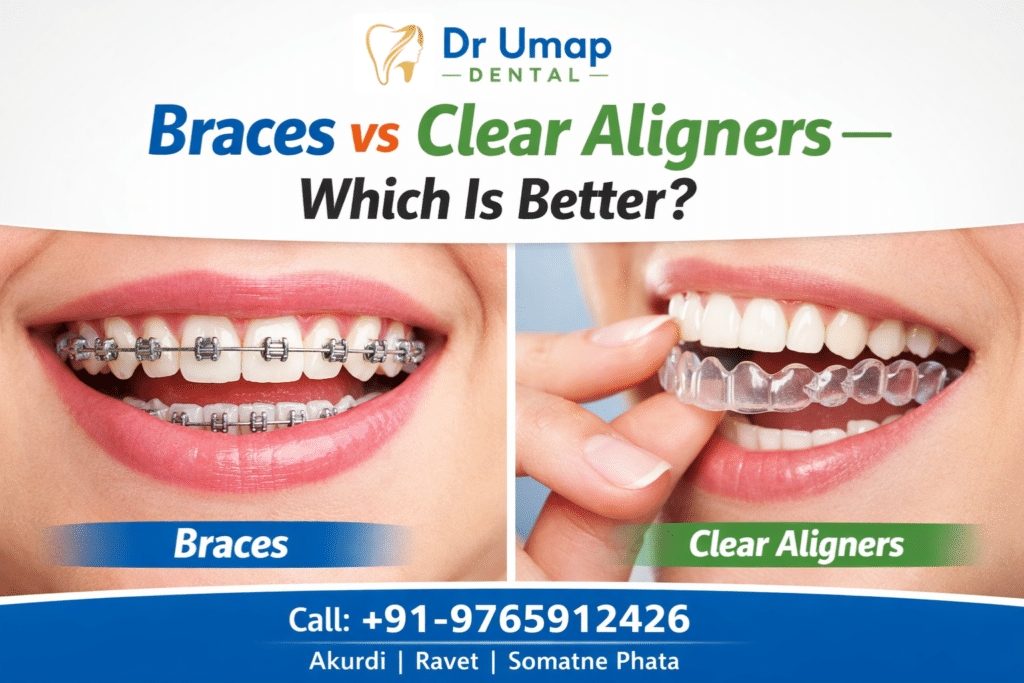
If you’re considering correcting your teeth alignment, you’ll typically come across two main options: traditional metal braces and clear aligners (such as Invisalign). Both are clinically approved methods that can effectively improve your smile. However, they differ in several aspects, including cost — particularly in India.
It’s a dilemma that we face almost every day at Dr. Umap. Dental: “Doctor, braces or aligners? Which is better?” Well, the honest answer to that is that it all depends on the type of teeth you have, your preferences, and budget constraints, among other things. So here’s the complete guide for you to be informed before your next visit.
Traditional braces, their operation, and modern types of braces
There is no need to give an elaborate description of traditional metal braces because such appliances have long been recognized as the benchmark treatment for misaligned teeth. These include metal brackets fixed to every individual tooth and joined by an archwire that is adjusted every few weeks by your orthodontist. Such pressure brings the teeth to the desired positions.
Nowadays, braces look different and are much more advanced than ever before. You may choose among the following options:
- Metal braces: Most popular type of braces due to high effectiveness and moderate price. Not discreet but can be used in any case, including complex problems with malocclusion.
- Ceramic braces (tooth-colored): Similar to metal braces but not noticeable due to the brackets’ color.
- Lingual braces: Braces attached to the inner surfaces of teeth, making them completely invisible to others but the most expensive type of braces.
What Are Clear Aligners, and How Do They Function?
Clear aligners, which became popular all over the world due to Invisalign, are a set of custom-made plastic devices shaped through digital 3D scanning technologies. The aligners are worn for about 1-2 weeks each and slowly move your teeth into the required final position.
Currently, there are a variety of clear aligners available in India, including Invisalign, Tooth, make, and other local options. It should be understood that the success of the treatment will depend not only on the brand of the device but primarily on the experience of the orthodontist prescribing your treatment plan.
These devices are practically imperceptible while wearing them, can be removed during meals and brushing, and do not restrict eating certain foods. Such properties make them extremely popular, especially among adults and people who are sensitive to aesthetics during treatment.
Braces vs Clear Aligners — At-a-Glance Comparison
Here is a comprehensive side-by-side comparison across the factors that matter most to patients:
| Factor | Metal Braces | Clear Aligners |
| Visibility | Highly visible (metal) | Nearly invisible |
| Comfort | Can cause irritation | Smooth plastic — fewer ulcers |
| Removability | Fixed / non-removable | Removable for eating & brushing |
| Oral Hygiene | Harder to maintain | Easy — brush and floss normally |
| Treatment Duration | 12–24 months (average) | 6–18 months (case-dependent) |
| Suitability | All cases incl. complex | Mild to moderate; some complex |
| Dietary Restrictions | Yes (avoid hard/sticky foods) | None — remove before eating |
| Dental Visits | Every 4–6 weeks | Every 6–10 weeks |
| Compliance Required | None — fixed appliance | Must wear 20–22 hrs/day |
| Whitening Option | Not possible during treatment | Can whiten simultaneously |
Clear Aligners vs Braces: Benefits and Drawbacks
Benefits of Metal Braces
- Suitable for treating any level of orthodontic condition (from straightforward to very difficult)
- Do not require patient cooperation (constant use at all times — they do their job irrespective of patient conduct)
- Normally considerably cheaper than aligners
- Best suited for young people who may struggle with using removable aligners
- Available in ceramic and lingual types for enhanced appearance when necessary.
Drawbacks of Metal Braces
- Very noticeable when applied to teeth (particularly metal braces)
- Mandate a change in diet — consumption of tough, sticky, and crunchy food should be strictly avoided.
- Demands increased attention and time during brushing around brackets and wires
- May produce discomfort, irritate soft tissues, and result in mouth sores
Benefits of Invisalign
- Almost invisible — ideal for professionals, orators, and those concerned with aesthetics
- Removable — can eat and drink without restriction; can brush your teeth normally without extra equipment
- Smooth plastic construction—greatly reduced soft-tissue damage compared to metal braces
- Orthodontic emergency appointments decreased since there aren’t any damaged brackets or wires to contend with.
- In some cases, whitening technology is utilized so that both processes happen simultaneously.
- Reduced number of appointments needed once the procedure begins
Drawbacks of Clear Braces
- Need disciplined patient compliance: must wear 20 to 22 hours each day without fail
- Unideal in some cases: severe crowding, spaces between teeth, and complicated bites will need regular braces.
- Damage or loss of the tray will seriously hamper the treatment process.
- Far more expensive compared to regular braces in India
- Any kind of food or drink, except water, needs removal of the aligner.
Are Clear Aligners Superior to Braces?
This is one of the top orthodontic queries on the Internet, but the answer depends on a lot more than you might expect at first. Neither method can be said to be superior in all cases because each has advantages that are exclusive to itself.
If you are an adult, professional, or someone who cares about their looks above anything else, wants complete freedom of movement in food, and is prepared to stick strictly to the prescribed course of treatment, then clear aligners may work best for you.
But if your orthodontic situation is complicated, or if you are trying to treat a child or teenager, or if money is a critical issue where even rupees are being counted, then you should go with braces.
In orthodontics, like in any field of medicine, the skill of the practitioner performing your treatment is by far the most crucial component to success.
Braces vs Clear Aligners – Which One is Quicker?
Time is among the most frequent complaints from the patients’ side. Here is how practice and scientific data compare:
- Mild to moderate cases: Aligners may prove quicker, taking 6–12 months to align the teeth successfully.
- Moderate to complex cases: Metal braces will always win hands down due to better predictability and controllability.
- Overall average: On average, both options require 12–18 months for all cases included.
A crucial factor for aligners: their efficiency is entirely dependent on your adherence to the schedule. Missing a few days with aligners on the schedule? Your time to completion gets pushed further by that number of days. Metal braces work non-stop day and night, no matter what happens.
Are Aligners Suitable For Every Case?
This is one of the most essential questions that people do not think about while searching for their orthodontic treatment on the internet. And the answer is negative – transparent aligners are not suitable for every case, and any experienced and professional orthodontist will definitely mention that.
Cases For Which Aligners Are Suitable
- Light to moderate crowding and spacing
- Light tooth rotations with minimal tooth movements required
- Overbites in most of the cases but not in all
- Relapse cases when teeth have been moved after braces treatment
- Patients who are known for having high compliance levels
Cases In Which Traditional Braces Are Preferable
- Severe crowding or misalignment with large movements required
- Large spaces between teeth with huge closure required
- Significant skeletal discrepancies (most likely to require a surgical-orthodontic procedure)
- Vertical bite malocclusions like open bites or deep bites
- Child or teenage patients with developing dentition
- Patients who cannot spend at least 20+ hours per day wearing their aligners
At Dr. Umap Dental, our clinical principle is always to be honest with our clients. And if we see that aligners are not appropriate for a patient’s case, we will inform the patient about that and why we believe that braces will work better for him/her.
Invisible Aligners vs Traditional Braces – Lifestyle Considerations
Apart from the clinical consideration, lifestyle is something that truly comes into play when deciding between invisible aligners and traditional braces. Take note of the following aspects when making your choice in accordance with lifestyle considerations:
- Career and Visibility: If you give presentations or interact with clients regularly, aligners will certainly boost your confidence.
- Food Intake: In case you enjoy hard or chewy foods, aligners offer an easier solution since they can be removed while eating.
- Sportspersons: Players who participate in contact sports find aligners more practical because of the reduced risk of lip or cheek injury.
- Swimmers: You need to take off your aligners while swimming to avoid bacteria buildup.
- Patients with Busy Lives: If you have a hectic schedule and travel regularly for work, the reduced number of clinic visits associated with aligners might suit you better.
- Young Patients: For children and teenagers, traditional braces are usually the best choice since the use of aligners involves higher levels of commitment and adherence.
Should I Choose Braces or Aligners According to Science?
Several orthodontic research papers comparing the results achieved using braces vs. aligners have been published. Here is an unbiased summary of the findings in scientific literature regarding their effectiveness:
- For relatively simple malocclusions, proper planning of aligners yields results no different from those of braces under a competent orthodontist’s supervision.
- Complex cases involving significant vertical and rotary movement require more accuracy and precision; braces consistently yield better results.
- Satisfied patient statistics reveal higher satisfaction rates with aesthetics and convenience among aligners, while braces users tend to feel they see results quicker.
- The necessity for long-term use of retainers is practically the same; retainer use is non-negotiable post-treatment.
Orthodontic science confirms the clinical consensus around the world: aligners vs. braces. Both are amazing treatments if used wisely by a competent orthodontist.
Retention After Orthodontic Treatment – The One Thing You Should Not Skip
Whether you choose conventional metal braces or aligners, your orthodontic treatment will continue even after the removal of your braces or completion of the final stage of your trays. It is because our teeth tend to shift back to their previous positions in what we call relapse.
At Dr. Umap Dental, each patient is provided with personalized retention recommendations, which include the following:
- Fixed (Bonded) Retainer – A thin wire attached to the inside surface of your front teeth, making it invisible to others. It works continuously without requiring any effort from your side.
- Removable Retainers – Clear retainers worn at night (or as recommended by your orthodontist). These are typically used as a post-treatment retention option, especially for patients who had clear aligners.
Wearing your retainer as advised is the key to protecting your results and ensuring your smile stays perfectly aligned for years to come.
The Way in Which Dr. Umap Dental Guides Your Decision
Dr. Umap Dental never advises treatments that are only profitable or widely used. We only advise the ones that are clinically correct and ideally suited for every patient’s unique case.
This is precisely what we offer during your orthodontic consultations with us:
- Detailed clinical examination of your dental structure, bite, jaws, and gums
- Digital X-rays along with OPG (oral panoramic radiography) if clinically necessary
- 3D scanning technology for accurate alignment assessments – no impression materials required
- Candidacy analysis based on clinical criteria alone—we will tell you if aligners don’t suit you
- Detailed cost structure and options of EMIs
- Practical timelines of your treatment journey
Frequently Asked Questions
Q1. Can I switch from braces to clear aligners midway through treatment?
In some cases, yes — but it depends on how much tooth movement has already occurred and what the remaining treatment requires. This needs a fresh clinical evaluation. It is not always advisable, and there will typically be additional cost implications involved.
Q2. Do clear aligners hurt less than braces?
Generally, yes. Clear aligners cause fewer soft tissue injuries because there are no metal brackets or wires. However, each new aligner tray does cause mild pressure and discomfort for approximately 2–3 days as your teeth adjust—similar in nature to the discomfort experienced after a braces tightening appointment.
Q3. Are cheap at-home clear aligners from online brands safe?
Exercise extreme caution here. Direct-to-consumer aligner brands — where you take your own impressions at home and are never assessed by an orthodontist in person — have been associated in documented cases with root damage, bite complications, and worsened tooth alignment. Orthodontic treatment requires professional supervision throughout. Your teeth are not something to compromise on.
Q4. How do I maintain proper oral hygiene with braces?
Use an orthodontic-specific toothbrush, interproximal (proxy) brushes, and a water flosser where possible. Brush thoroughly after every meal and floss at least once daily. Your orthodontist will demonstrate the correct cleaning technique at your first appointment and at every subsequent visit.
Q5. Is it true that aligners are only suitable for cosmetic cases?
No—this is a common and persistent misconception. Modern aligner systems are clinically capable of treating a wide range of functional bite issues, not only cosmetic concerns. However, structurally complex cases involving significant jaw or skeletal discrepancies still most commonly require traditional braces or a carefully coordinated combination approach.
Q6. What is the right age to begin orthodontic treatment?
Children can benefit from early interceptive orthodontic treatment from approximately age 7–8 to guide jaw growth and prevent more serious issues. Full orthodontic treatment typically begins around age 11–14 when most permanent teeth have erupted. Crucially, there is absolutely no upper age limit—adults of any age can achieve excellent outcomes with orthodontic treatment, provided their gum and bone health is good.
Final Word on Braces versus Clear Aligners – Which One Is Better?
There is no simple answer, and if an orthodontist gives you one, then he/she may very well be trying to sell you something! Your treatment will be better when:
- It fits your unique clinical situation effectively.
- It matches up with your lifestyle.
- It suits your financial reality.
- You are going to use it consistently for the duration of your orthodontic journey.
If your dental situation or circumstances match any of those above, then braces are still unbeaten. If you are a good candidate for clear aligners and able to commit fully, then aesthetics and lifestyle cannot get any better!
But the first thing you should do right now is stop reading yet another blog and book a consultation with a competent orthodontist!