

Should your dentist have suggested a root canal for you, chances are that fear will overwhelm you—and rightly so. In the past, root canal treatments were unnecessarily feared as being very painful. However, the truth is root canals are some of the most efficient treatments in contemporary dentistry, and, contrary to popular belief, the pain during the procedure will be a lot less than the one caused by the toothache.
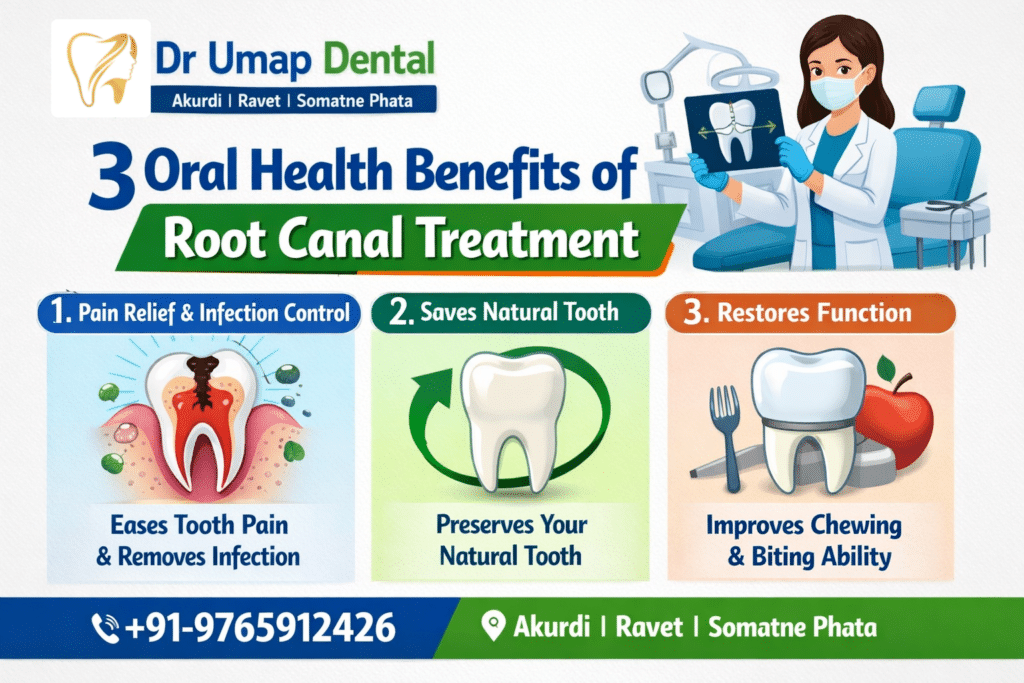
At Dr. Umap Dental, we strongly believe in the importance of informing our patients on their condition. Therefore, in this article, we have compiled a list of the top 3 key oral benefits of having root canal treatment.
What Is Root Canal Treatment? An Easy-to-Understand Description
Before we discuss the advantages of root canal treatment, it’s essential that you first know what the process entails since the most common cause of dental anxiety among patients is fear of the unknown.
Root canal treatment is the procedure used by dentists to address infections or problems present inside the tooth. The tooth’s pulp contains nerves and blood vessels, and when it becomes infected or irritated, root canal treatment is needed to preserve the tooth.
This is accomplished through the following steps:
→ Removing the infected or affected pulp
→ Disinfecting and cleaning the canals in the tooth
→ Filling and sealing the tooth to ensure it does not become infected again
→ Crowning the tooth to restore its function and aesthetics
Modern anesthetic agents and dental technology make the process relatively pain-free for patients.
Benefit #1: It Removes Infection and Prevents Bacterial Spread
By far, the most crucial reason for root canal therapy to be vital is its capacity to remove a hazardous dental infection from your mouth before it leads to permanent harm.
What Does an Infected Tooth Mean?
When harmful bacteria enter your tooth through cavities, fractures, or cracks and infect the inner pulp of your tooth, an infection occurs. Not only does this infection cause harm to your tooth, but it can also lead to:
- Surrounding gum tissues
- Adjacent teeth
- The jawbone (resulting in bone loss)
- In extreme cases, the bloodstream (a condition known as bacteremia, which impacts heart health)
Dental abscesses are painful complications that occur when an infected tooth is not treated promptly, appearing in the form of a pus-filled sac around the root of your tooth. Untreated abscesses will eventually burst and transmit bacteria throughout the mouth and throat area.
Stopping Infection Spread Through Root Canal Therapy
The process of root canal therapy tackles the infection from its root cause. By completely cleaning out the diseased pulp and disinfecting the root canals using antimicrobial solutions, this treatment will:
- Instantly stop the bacteria from spreading further
- Cure the throbbing pain brought about by inflamed pulp
- Avoid the requirement for tooth removal because of infection spread.
- Save neighboring teeth from contracting the same infection
Benefit #2: It Keeps Your Tooth Natural – and This Is Far More Important Than You Realize
Among the most overlooked benefits of root canal treatment is keeping your tooth natural. With such remarkable substitutes as implants and bridges now available on the market, it’s easy to think, “What’s wrong with taking out the tooth?” The thing is, dentistry is very clear—nothing beats the real thing.
Why Your Natural Tooth Matters
Your natural teeth get held within the jaw by the periodontal ligament, which is basically a complex of fibers through which forces of chewing get distributed into the bone. In effect, your tooth provides constant stimulation for the surrounding jawbone. Without your natural tooth:
- Bone absorption starts occurring in a matter of months around the extraction site.
- Nearby teeth begin to move into the empty space.
- Sunken cheeks might become noticeable over time
- Efficiency of chewing is reduced.
Why Root Canal Therapy Helps You Save the Tooth
With root canal therapy, your tooth is saved by cleaning the infection from within the tooth while maintaining its structure. It will:
- Enable you to retain the stimulation of your jawbone due to the tooth root
- Keep your bite structure untouched.
- Help the restored tooth behave just like other teeth
- Cost you less than having to extract and replace the tooth
“Isn’t a decayed tooth dangerous?”
One of the most frequently asked queries by our patients at Dr. Umap Dental is whether a decayed tooth causes trouble. Once the pulp of the tooth is extracted in a root canal procedure, there will be no nerves in it anymore—which does not necessarily imply that it poses a threat to your health. Provided that the tooth is properly crowned, it can serve for decades to come. Besides, there will be no functional differences when chewing or biting.
Benefit #3: It Removes Intense Pain and Helps You Regain Your Quality of Life
The first noticeable benefit of undergoing a root canal is that it helps remove pain and allows you to regain your quality of life. There is an irony in getting a root canal because most patients dread the procedure and fear the pain associated with it. On the contrary, root canal treatment is designed to treat painful dental infections.
What Causes Pain Prior to Treatment
Painful sensations are experienced due to infections in the tooth pulp. Common symptoms include:
- Persistent tooth pain that becomes worse during the night
- Sharp pain while chewing or biting down
- Excessive sensitivity to hot or cold foods or drinks
- Jaw, facial, or gum swelling
- Tender and swollen lymph nodes
- Bad taste in the mouth due to an abscess
As such, you should know that the pain does not go away without proper treatment; in fact, it gets worse.
How Root Canal Therapy Helps Relieve Pain
The root canal procedure targets the problem at its source, namely, the infected and irritated pulp tissue. Upon removal and cleaning and sealing of the canals:
- The toothache usually disappears within 24–48 hours after the treatment.
- Sensitivity to cold and hot foods becomes normal
- Swelling on the face starts to go down
- Individuals can talk, sleep, and eat without experiencing pain.
In our clinic, Dr. Umap’s Dental, local anesthetic is used for all treatments, which means that many patients do not experience any pain during the process. Soreness may appear in the days after treatment, but it is manageable with over-the-counter pain medications.
Signs You May Need Root Canal Treatment
Not every toothache means you need a root canal — but certain symptoms are strong indicators that the pulp may be infected or damaged. Visit Dr Umap Dental promptly if you notice:
| Symptom | What It May Indicate |
| Persistent, severe toothache | Pulp inflammation or infection |
| Pain when biting or chewing | Damaged or infected root tissue |
| Prolonged heat/cold sensitivity | Nerve damage within the pulp |
| Gum swelling or tenderness | Possible dental abscess forming |
| Darkening or discolouration of tooth | Pulp tissue death (necrosis) |
| Small pimple on gums | Abscess with drainage channel (fistula) |
Your Guide to a Root Canal Treatment at Dr. Umap Dental Clinic
Our understanding that knowledge about the process can reduce your anxiety has led us to provide you with the following information regarding the root canal procedure:
Step 1—Evaluation & X-Ray: First, the extent of the infection is checked through digital X-rays to evaluate the structure of the canals in the affected tooth.
Step 2 – Anesthesia: Next, the entire area will be numbed for your absolute comfort.
Step 3 – Pulp Removal: An access opening is created on the crown of the tooth to remove the infected pulp.
Step 4 – Canal Preparation & Shaping: Specialized instruments are used to clean and prepare each canal.
Step 5 – Filling & Sealing: The root canals are filled with gutta-percha material, and they are sealed to ensure no infection occurs again.
Step 6 – Crown Installation: A custom-made crown is placed on top of the treated tooth.
Frequently Asked Questions About Root Canal Treatment
Is root canal treatment painful?
No—not with modern techniques and anesthesia. You may feel mild soreness for a few days after the procedure, but the intense pain of the infection is relieved almost immediately.
How long does root canal treatment take?
Most root canals are completed in one to two appointments, each lasting 60–90 minutes, depending on the complexity of the case.
How long does a root-canal-treated tooth last?
With proper oral hygiene and a well-fitted crown, a treated tooth can last a lifetime. Regular check-ups at Dr. Umap Dental ensure it stays healthy.
Is root canal treatment better than extraction?
In most cases, yes. Saving your natural tooth preserves jawbone, bite alignment, and facial structure. Extraction creates gaps that require additional treatment (implants or bridges) at greater cost and complexity.
What are the advantages of root canal therapy over waiting?
Waiting only allows the infection to spread, intensify the pain, damage surrounding teeth, and increase treatment complexity and cost. Early root canal treatment resolves the problem efficiently and permanently.
Conclusion: Root Canal Procedure – Investing in Your Smile’s Future
In addition to relieving pain and discomfort caused by infected teeth, a root canal procedure offers a plethora of other advantages. These include prevention of harmful bacteria from spreading further, retention of your precious natural tooth, and regaining the ability to enjoy normal oral health and confidence.
Dr. Umap Dental takes great pride in its meticulous attention to detail when performing root canal procedures. Our highly skilled dentists always perform root canals with the utmost precision and the most up-to-date technologies. Therefore, you can rest assured that all procedures will be carried out flawlessly and without pain.
Do not wait for further deterioration of your oral health to get a root canal procedure done. Contact us now!